


Dyness PowerBrick Plus: A Practical 16 kWh Low-Voltage LFP Battery Guide
Specification review date: 17 October 2026 (Beijing Time)
Specification basis: Dyness PowerBrick Plus datasheet, file version 20251210-EN
Executive takeaway
The Dyness PowerBrick Plus is designed for buyers who need more energy per battery unit than a conventional 5–10 kWh residential module can provide. One cabinet offers 16.07 kWh nominal and 15.27 kWh usable energy, a 51.2 V low-voltage architecture, up to 200 A charge and discharge current, IP65 protection and expansion to 50 parallel units. Its strongest fit is a high-consumption home, rural property, small office or light commercial site where backup duration and future expansion matter more than minimum footprint or minimum initial cost.
The important procurement point is that battery capacity alone does not define system performance. The selected inverter, permitted battery current, backup output, PV input, phase arrangement, protection devices and local installation rules determine how much of the PowerBrick Plus capability can actually be used.
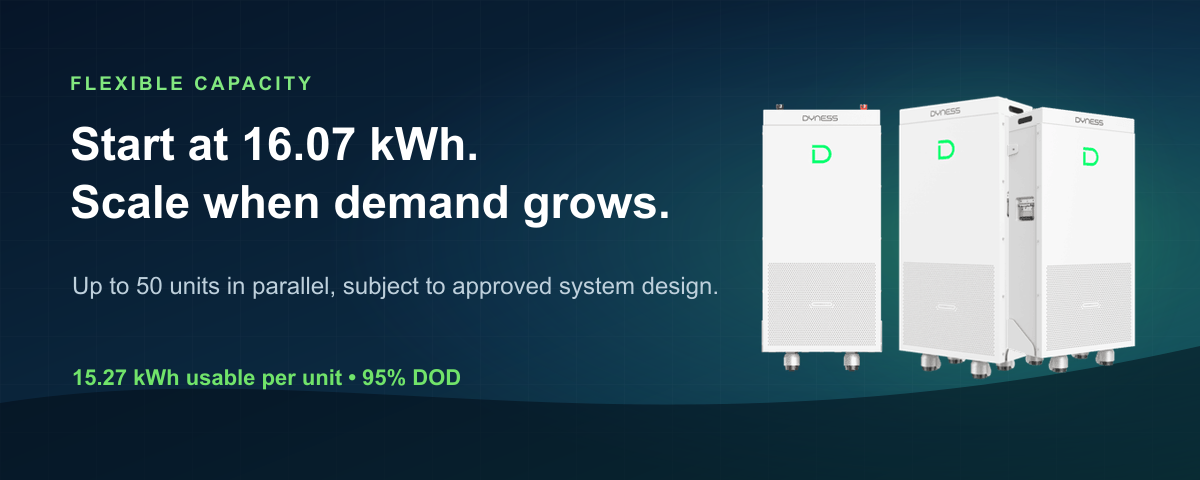
Core specifications
| Item | PowerBrick Plus specification |
|---|---|
| Battery chemistry | LiFePO4 (LFP) |
| Nominal / usable energy | 16.07 kWh / 15.27 kWh |
| Nominal capacity / voltage | 314 Ah / 51.2 V |
| Operating voltage | 44.8–57.6 V |
| Recommended current | 140 A charge and discharge |
| Maximum / peak current | 200 A maximum; 300 A peak for 2 minutes at 25°C |
| Recommended / maximum power | 7.168 kW / 10.24 kW charge and discharge |
| Depth of discharge / cycle life | 95% / ≥8,000 cycles under stated test conditions |
| Protection / communication | IP65 / CAN and RS485 |
| Interface / installation | Wi-Fi + app / floor-mounted or wall-mounted |
| Expansion / warranty | Up to 50 units in parallel / 10 years, subject to the warranty letter |
| Certification / safety | UN38.3 / IEC 62619; built-in aerosol fire extinguisher |
| Dimensions / net weight | 435 × 235 × 850 mm / 119 kg |
Revision note: Dyness may display rounded or revised values on its live product page. This guide follows the supplied datasheet version 20251210-EN. Procurement documents should always reference the exact current datasheet and warranty letter supplied with the quotation.
What makes the product commercially interesting
More energy per cabinet
At 15.27 kWh usable energy, one PowerBrick Plus can cover a meaningful evening and overnight load without requiring several small battery modules. That simplifies the product story for homeowners who want to retain refrigeration, lighting, networking, pumps, office equipment and selected kitchen or heating-support loads during an outage.
The cabinet is not a universal whole-home backup guarantee. Runtime depends on the real load profile. A 1 kW average load is theoretically close to 15 hours before conversion losses and reserve settings; a 5 kW average load reduces that theoretical window to roughly three hours. The installer should size from measured kWh consumption and the maximum simultaneous kW load, not from battery capacity alone.
A useful power envelope for residential and light commercial systems
The recommended 140 A operating current corresponds to 7.168 kW at nominal voltage, while the specified 200 A maximum corresponds to 10.24 kW. This makes the battery relevant to substantial single-phase systems and selected low-voltage three-phase solutions, provided the inverter and cabling are designed for the current. The limiting component may be the inverter battery port rather than the battery itself.
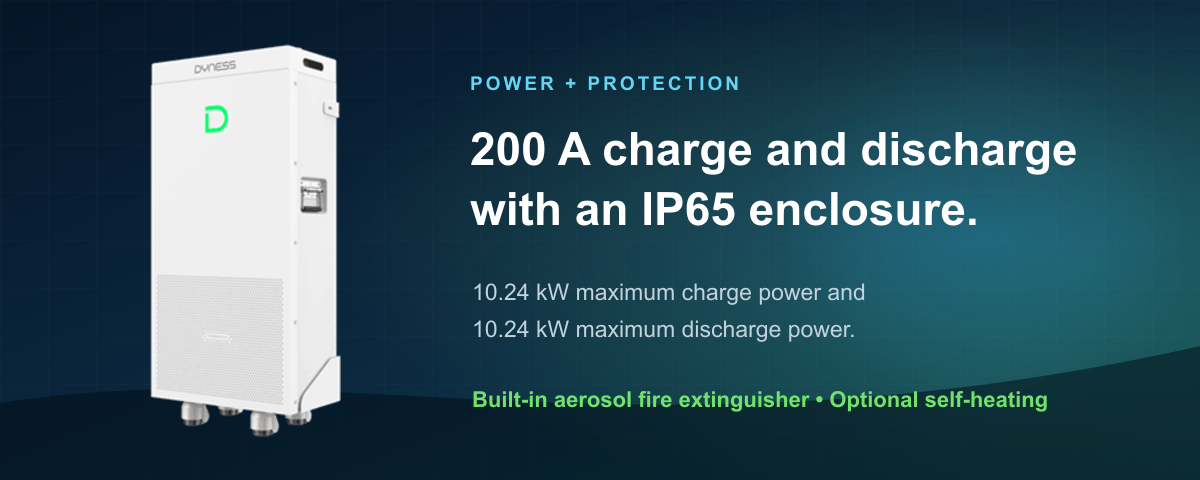
Outdoor-capable enclosure with installation flexibility
IP65 supports properly designed indoor or outdoor installation, but IP65 does not remove the need for shading, drainage, clearances, mechanical protection and compliance with local electrical and fire rules. The optional self-heating version expands the charging temperature range down to -20°C; buyers in cold climates should confirm that the quoted model actually includes this option.
Floor mounting is the natural choice for many projects because the unit weighs 119 kg. Wall mounting should only be used on a verified load-bearing structure with the approved bracket and clear installation access. Optional regulating wheels can help positioning but do not replace secure final installation.
Built-in monitoring and safety functions
The PowerBrick Plus provides CAN/RS485 communication, Wi-Fi/app access and a built-in aerosol fire extinguisher. These are valuable features, but commissioning still depends on correct inverter protocol selection, firmware compatibility, overcurrent protection, isolation, cable sizing and local inspection requirements.
Who should buy it
- High-consumption homes that need more than a 5–10 kWh entry battery.
- Rural properties where pumps, refrigeration, communications or security loads require longer backup.
- Homes with larger PV arrays that want to increase self-consumption instead of exporting low-value solar energy.
- Small offices, shops and workshops with a clearly measured critical-load circuit.
- Buyers who expect future demand growth and want a platform that can expand in parallel.
- Installers and distributors seeking a high-capacity 51.2 V LFP option compatible with a broad inverter ecosystem.
Who should not buy it
- Apartments with limited floor loading, access or installation clearances.
- Small backup applications where a 2–5 kWh battery would cover the required loads at lower cost.
- Projects requiring high-voltage battery architecture.
- Buyers expecting all household loads to operate indefinitely without load management.
- Systems using an inverter model or firmware that has not been confirmed on the current Dyness compatibility list.
- Outdoor projects without shade, drainage, cable protection and a compliant installation plan.
Recommended configurations
Good: 16.07 kWh single-battery system
Use one PowerBrick Plus with a compatible inverter sized around the actual critical-load requirement. This is a strong starting point for household backup and solar self-consumption where 15.27 kWh usable energy is sufficient. Confirm that the inverter's continuous battery current and backup output match the load plan.
Better: 32.14 kWh dual-battery system
Two units in parallel approximately double the nominal energy and reduce the current burden per cabinet when the system is configured correctly. This arrangement suits larger homes, farms, remote properties and small businesses that need longer autonomy or higher daily cycling capacity.
Best: engineered multi-unit system
Three or more units can support high-demand residential or light commercial projects. At this scale, treat the installation as an engineered energy system: verify current sharing, protection and isolation, busbar design, cable lengths, inverter limits, ventilation, fire separation, monitoring and the manufacturer's parallel-connection requirements. The stated maximum of 50 units is a product capability, not a substitute for project engineering.
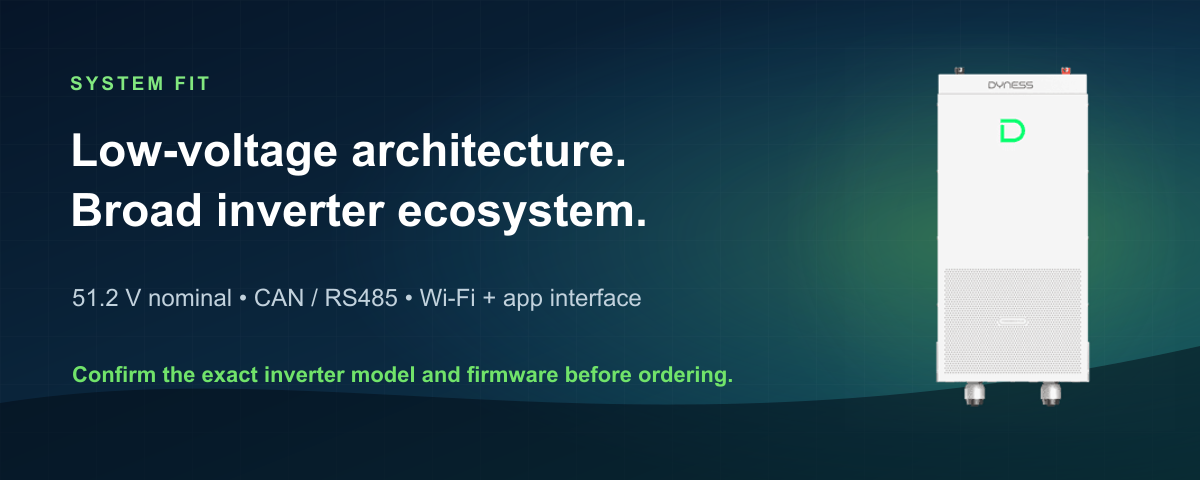
Inverter compatibility: read the model-level detail
The supplied datasheet names Solis, GoodWe, Growatt, SMA, Victron, Deye and APsystems among compatible inverter brands. Brand-level compatibility is only the first filter. Before purchase, confirm the exact inverter model, firmware, battery protocol, number of parallel batteries, approved cable set, charge/discharge current limits and any required communication hub.
For low-voltage systems, high DC current makes cable length and conductor sizing especially important. A system that is electrically compatible on paper can still be poorly designed if voltage drop, terminal rating, isolation or overcurrent protection is ignored.
Buying checklist
- Confirm whether the quotation is for the standard or optional self-heating version.
- Match the exact inverter model and firmware to the current compatibility list.
- Check inverter battery-voltage range, continuous current and backup-output rating.
- Size energy from daily kWh consumption and power from simultaneous kW demand.
- Confirm the number of batteries, parallel hardware and communication topology.
- Verify cable cross-section, cable length, DC isolation and overcurrent protection.
- Confirm floor loading or wall structural capacity for the 119 kg cabinet.
- Plan outdoor shading, drainage, clearances and physical protection where applicable.
- Obtain the current warranty letter and commissioning requirements.
- Verify local electrical, building and fire-safety rules before installation.
European procurement
Solligent can support European project quotations for Dyness PowerBrick Plus subject to confirmation of stock, delivery country, quantity and technical configuration. Send the intended inverter model, project location, required usable energy, maximum backup load and target delivery date. A current quotation can then confirm availability, lead time, VAT treatment, accessories and warranty documentation.
Request a current quotation. Prices and inventory are not stated in this guide because they can change by country, quantity, freight terms and configuration.